
Introduction
Climate change and global warming, despite existing contradictions, are two of the most pressing issues at this time. We need to deeply understand or act on these issues, as they impact the environment, human health, agriculture, the economy, and global peace. The United Nations has declared climate action as one of the top priorities under the Sustainable Development Goals (SDGs). Students or anyone preparing for competitive exams should understand this issue, as questions related to it are often asked in the essay, comprehension, current affairs, and general studies sections.
Table of Contents
What is Climate Change?
Climate change refers to long-term changes in temperature and weather patterns, largely caused by human activities, such as deforestation, excessive pollution, and the overuse of modern appliances (such as air conditioners).
Natural factors such as volcanic eruptions, changes in the Earth’s rotation, continental drift, and solar fluctuations contribute to climate change, but today the primary cause is human-caused greenhouse gas (GHG) emissions.
What is Global Warming?
Global warming is the gradual increase in the Earth’s average surface temperature due to human activities such as deforestation, burning of fossil fuels for energy production, etc. This is caused by rising levels of greenhouse gases (CO₂, CH₄, N₂O).
This is one of the major aspects of climate change.
In short: Global warming is the rise in temperature, while climate change is the broader shift in the Earth’s weather systems.
Causes of Climate Change & Global Warming
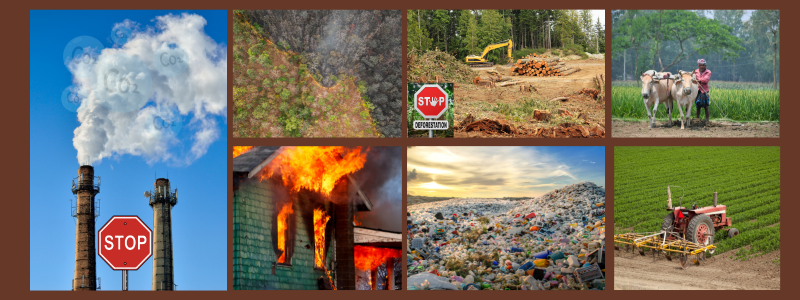
Climate change and global warming are primarily caused by natural factors and human activities, as described below.
Natural Causes
Although their impact (climate change and global warming) is considerably less than that of current human activities, they still play these roles:
- Volcanic Eruptions – Release carbon dioxide, ash, and particles into the atmosphere, temporarily affecting global temperatures.
- Solar Variations – Fluctuations in solar radiation can slightly warm or cool the Earth.
- Ocean Currents & El Niño – Changes in ocean circulation patterns influence global climate.
- Earth’s Orbit (Milankovitch Cycles) – Shifts in tilt and orbit affect long-term climate cycles (ice ages, warming periods).
Human-Induced Causes
Human activity plays a significant role in today’s climate change, and it is a major factor.
(a) Greenhouse Gas Emissions
Greenhouse gases are warming the world faster than at any time in at least the last two thousand years. and Climate scientists have shown that humans are responsible for much of the global warming over the past 200 years.
- Carbon dioxide (CO₂): Produced by the burning of coal, oil, and natural gas (power plants, vehicles, industry).
- Methane (CH₄): Produced by animals, rice fields, landfills, and oil and gas extraction.
- Nitrous oxide (N₂O): Produced by fertilizers and industrial activities.
- Chlorofluorocarbons (CFCs): Used in refrigeration and aerosols (also cause ozone depletion).
(b) Deforestation
- Cutting down trees reduces CO₂ absorption and oxygen depletion.
- Burning forests releases stored carbon into the atmosphere.
(c) Industrialization and Urbanization
- Factories emit greenhouse gases and particulates.
- Growing cities increase vehicle use, construction dust, and energy consumption.
(d) Farming Practices
- Excessive use of chemical fertilizers → Nitrous oxide emissions.
- Rice fields → Methane release.
- Livestock raising (cattle, sheep) → Methane from digestion.
(e) Waste Generation
- Landfills release methane during the decomposition of organic waste.
- Improperly burning waste releases CO₂ and toxic gases.
Table of Cause and Effect of Climate Change and Global Warming
| Cause | Effect on Climate |
|---|---|
| Greenhouse Gas Emissions | Traps heat, raises global temperature |
| Deforestation | Reduces CO₂ absorption, increases warming |
| Industrialization | Increases pollution & GHG emissions |
| Agriculture | Emits methane & nitrous oxide |
| Waste Mismanagement | Methane release from landfills |
| Natural Factors | Solar, volcanic, oceanic influence |
Impact of Climate Changes and Global Warming
The extent of damage to nature and humanity from climate change and global warming is evident worldwide, and its effects are becoming more severe.
Environmental Impacts
- Melting of glaciers and polar ice caps
- Continuous population growth
- Rising sea levels, threatening coastal areas
- More intense heatwaves, droughts, and cyclones
- Biodiversity loss and ecosystem imbalances
- Coral reef bleaching and ocean acidification
- Continuous deforestation
Social and Economic Impacts
- Decreased agricultural productivity → food shortages
- Continuously increasing pollution
- Increase in climate-related diseases
- Damage to infrastructure and livelihoods
- Climate migration and displacement of communities
- Economic losses from natural disasters
India, in particular, is facing extreme heat, erratic monsoons, floods, and biodiversity loss—making climate resilience a top priority.
Conclusion
Climate change and global warming are now posing a growing threat worldwide. Rising temperatures, melting ice caps, strange weather patterns, and ecological problems worldwide clearly demonstrate that our planet is under immense pressure. Human actions have accelerated these changes, but we also have the power to reverse them if we improve our activities and make them more bio-friendly. By adopting sustainable practices, investing in clean energy, protecting forests and biodiversity, and working together at the global and local levels, we can still create a stable and healthy future. Climate action isn’t just a responsibility—it’s a necessity for the survival of all life. The decisions we make today will determine the kind of world we leave behind for future generations. Let’s take action now to protect our planet.
External Links
- What is EI Nino and what are its impact? USGS Science for a changing world
- Climate Change– United Nation (Climate Action)
References
- Climate Change– United Nation (Climate Action)