
Introduction

Maritime Transport is a critical infrastructure for the social, improvement of trade and economic development of a country.This critical infrastructure of ports influences the pace, structure, and nature of development. Ports in India are divided into two categories, one is major ports and the other is minor ports.There are 12[A] major ports and 200 non-major ports (minor ports) in the country as of august 2025.India’s major ports are the backbone of India’s international commerce.
India’s ports handle approximately 90% of EXIM cargo by volume and 70% by value. To increase the country’s trade capacity, port capacity has always been a priority.During April-March 2024-25 cargo handled at Non-Major Ports increased by 2.22%[B] compared to April-March 2023-24.
Table of Contents
Classification of Ports
The ports of India are mainly divided into two parts.
Major Ports
- The purpose of major ports is to provide necessary and convenient cargo handling capacity to cater to India’s export-import trade such as petroleum, electronics, iron core and fertilizers etc.
- Major ports are administered by the Ministry of Ports, Shipping and Waterways under the Government of India.
- There are 12[A] major ports in India.
- India’s major ports are the backbone of India’s international commerce and play a wide-ranging role in trade, economy, connectivity and security.
- All the 12 Major Ports are governed under the Major Port Trusts act, 1963.
Non-Major Ports
- Non-major ports is also called the Minor Ports.
- There are 200[A] minor ports in India.
- Out of the 200 non-major ports, approximately 65[A] handle trade, and the remaining ports are not used for trade.
- All the Non-Major Ports (minor ports) are governed under the IPA Act, 1908 which consists of 69 sections and two schedules.
- Non-major ports come under the jurisdiction of the State Maritime Boards of the respective state governments.
- Private ports under the operating in public private partnership (PPP) model.
Function and Importance of Ports
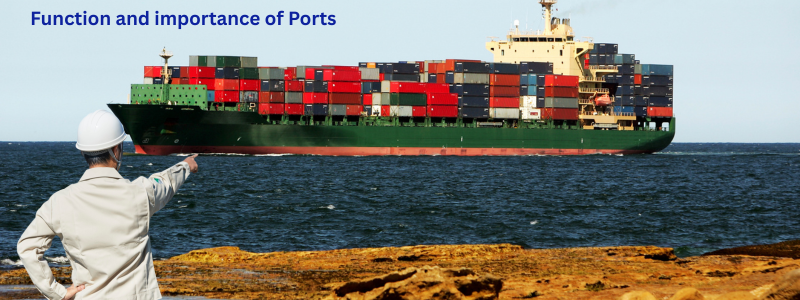
The ports of India play a very important role in India’s ferry services, trade and revenue generation etc.
- India’s ports are designed to ensure smooth, time-efficient, and cost-effective trade. They handle almost all EXIM cargo.
- Some of the function of Major Ports such as
- Cargo Handling
- Connectivity & Logistics
- Facilitating International Trade
- Revenue Generation etc.
- Some of the function of Minor Ports such as
- Handle small to medium-sized cargo volumes
- Facilitate passenger movement through ferries, especially in coastal states and islands.
- Fishing & Marine Activity
- Useful for relief operations during cyclones, floods, or other coastal disasters etc.
- Ports promote industrialization and regional development and contribute significantly to GDP. Overall, India’s ports are a significant contributor to the development of the economy.
- ports are vital during emergency such as natural disasters and and the technical break down in ferry for supplying essential goods, fuel, and medicines.
List of Major Ports in India
This list includes a total of 13 major ports in India. The features of each port in India are also explained individually, which are extremely important for exam and general knowledge purposes.
| S.N | Port Name | Est. Year | State/UT | Trade | Key Features |
|---|---|---|---|---|---|
| 1 | Kandla Port (Pt. Deendayal Upadhyay Port) | 1965 | Gujarat | Petroleum, electronics, salt and fertilizers | -It is a tax-free port in India. -One of the largest port in cargo volume. |
| 2 | Mumbai Port | 1873 | Maharashtra | Automobile, fertilizers, and Engineering | -It is India's largest port based on trade. -Artificial port |
| 3 | Jawaharlal Nehru Port (Nhava Sheva) | 1988 | Maharashtra | Containers and automolies | -India’s busiest container port. Strong container traffic. -It is fully computerized port -It is India's largest artificial port. -Nehru Port was built to reduce the load on Mumbai Port. |
| 4 | Mormugao Port | 1985 | Goa | Iron ore, coconut and fish | -Located on the bank of Mandobi river. |
| 5 | Mangalore Port | 1974 | Karnataka | Iron ore, fertilizers and fish | |
| 6 | Cochin Port | 1928 | Kerala | Seafood, beetle and leather goods | -All trade is conducted through the Arabian Sea. -This is an old port. |
| 7 | Chidambaranar Port (Tuticorin Port) | 1974 | Tamil Nadu | Salt, edible oil and coal | -it provide weekly container service to USA. |
| 8 | Chennai Port | 1881 | Tamil Nadu | Containers and automobiles | -It is a second largest artificial port of india -It conduct trade with Srilanka |
| 9 | Ennore Port (Kamarajar Port) | 2001 | Tamil Nadu | Automobile, containers, chemical and petroleum product | -it also called the Kamarajar Port |
| 10 | Visakhapatnam Port | 1933 | Andhra Pradesh | Iron ore, coal, petroleum, and fertilizers | -It is a deepest port. |
| 11 | Paradip Port | 1966 | Odisha | Iron ore and coal | |
| 12 | Kolkata Port (Syama Prasad Mookerjee Port Trust) | 1970 | West Bengal | Jute, sugar, fertilizer and heavy machinery | -Second largest port in India -On the bank of Hughly river. |
| 13 | Haldia Port | 1977 | West Bengal | Chemicals and petroleum products | -Haldia Port was built to reduce the load on Kolkata Port. |
Conclusion
India’s ports play a vital role in low-cost and short-term export and import, economic growth, strategic presence in the Indian Ocean region, connectivity and logistics, and the services of passenger ferry and international cruises.The Indian government is continuously implementing programs to make ports more sustainable, such as green projects. For example, Mormugao has been declared India’s first green port. Recent emphasis on large-scale projects, green port status, automation, and policy support are moving the sector in a positive direction. Therefore, India’s ports are the backbone of India.
External Link
- Public Private Partnership pppindia modal– Department of Economics Affairs
- Indian Ports Association: Location of major Port-An apex body of major ports under the Ministry of Ports, Shipping and Waterways
- Mormugao has been declared India’s first green port-The Times of India
References
- Ports Wing. Ministry of Ports, Shipping, and Waterways | Government of India
- Cargo handled by Non-Major Ports in India : Cargo handling stutus for non major ports of State Maritime Board/Directorate of Ports, March 2025