
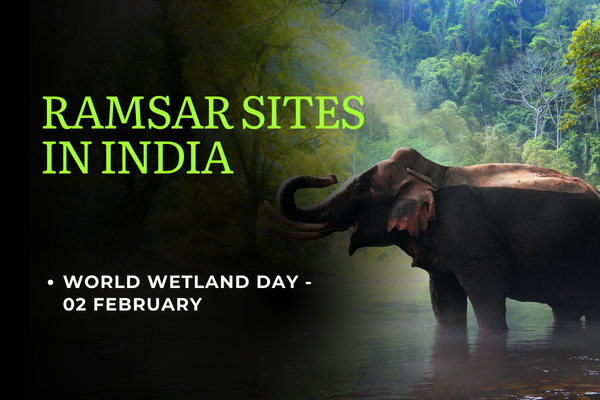
What is Ramsar Site?
The Ramsar site is a wetland area and its arise from the growing global recognition of the ecological and ecosystem importance of wetlands and the need to protect them because of increasing threats from human activities. Ramsar site is also known as “convention on wetlands”.
Table of Contents
History of Ramsar Site
- Ramsar Convention treaty signed: 02 Feb 1971
- First time World Wetland day celebrate: 02 Feb 1977
- World Wetland Day: 02 February
- India sign the Ramsar convention: 01 Feb 1982
The Ramsar Convention treaty was signed on 2 February 1971 in the Iranian city of Ramsar on the shores of the Caspian Sea under the conservancy of UNESCO. It is also known as “convention on wetland”. It came into force on 21 December 1975. It is an international environmental treaty.
World Wetlands Day was first celebrated on 2 February 1997 after 16 years of the Ramsar Convention.
Ramsar Convention in India
India signed the Ramsar Convention on 1 February 1982 and Chilka Lake (Odisha) was first included in the Ramsar List in 1981.
These wetlands not only protect biodiversity but also support livelihoods through fishing, aquaculture, migratory bird habitats, tourism, and agriculture.
What is Wetland?
Wetlands are areas where moisture, marshy land and peatland or water areas always remain. In which abundant moisture is found. And where water remains filled all or partially throughout the year.
- Wetlands are also called the “kidneys of the landscape”. Just like the kidneys in the body purify water, wetlands also purify water through the water cycle and remove polluted elements quickly.
- Wetlands are also called “biological supermarkets” because they form an elaborate food web.
- Peatland is a type of wetland that is formed due to waterlogging for a long time. In this situation, the plants are not able to decompose completely and form soil. Organic matter is found in it.
Facts about Ramsar Site
- As of August 2025, there are 2544 Wetlands in the world.
- As of August 2025, there are 91 Wetlands in India.
- Wetlands Day is observed on February 2.
- India’s first Ramsar site: – Chilka lake (Odisha,01 oct 1981)
- India’s largest Ramsar site which is famous for mangrove forests: – Sundarbans (West Bengal, Area 4230 km²)
- India’s smallest Ramsar site: – Renuka Wetland (Himachal Pradesh)
- Asia’s largest saltwater lake: – Chilka lake (Odisha)
- India’s famous bird sanctuary: – Keoladeo Ghana National Park (Rajasthan)
- World’s only floating lake: – Loktak lake (Manipur)
- Famous site for hosting thousands of migratory Demoiselle Cranes every winter: – Khichan (Rajasthan, Phalodi district)
- Known as bird village: – Menar (Rajasthan, Udaipur district)
- State with most Ramsar sites: – Tamil Nadu (20 Ramsar Site)
New Ramsar Site in India
These new wetlands of India have been included in the Ramsar List, taking the number of Ramsar sites in India to 91.
Khecheopali Lake
It is the 88th Wetland located in Sikkim. This site was added to the Ramsar list on 02 February 2025.
Udhwa Lake
It is the 89th Ramsar site located in Jharkhand. This site was added to the Ramsar list on 02 February 2025.
Khichan Wetland
It is the 90th Ramsar site located in Rajasthan, Phalodi district. This site was added to the Ramsar list on 04 June 2025. The site is famous for hosting thousands of migratory Demoiselle Cranes every winter.
Menar Wetland
It is the 91th Ramsar site located in Rajasthan, Udaipur district. This site was added to the Ramsar list on 04 June 2025. It is also known as bird village.
Type of Ramsar Sites
Lakes and freshwater wetlands
Natural or man-made water bodies that support a vast area of biodiversity.
Examples:
- Loktak Lake (Manipur): Famous for floating phumdis (floating islands of vegetation and mud) and Sangai deer.
- Wular Lake (Jammu and Kashmir): One of the largest freshwater lakes in Asia.
- Sasthamkotta Lake (Kerala): Largest freshwater lake in Kerala.
Rivers and floodplain wetlands
These wetlands are formed along river systems, seasonal floodplains, or low-lying areas inundated by river water.
Examples:
- Kanjli Wetland (Punjab): Formed along the Kali Bein River.
- Keshopur: Miani Community Sanctuary (Punjab): It is an important floodplain wetland. And it is one of India’s first community sanctuaries, a haven for migratory bird species.
- Nanda Lake (Goa): It is a freshwater floodplain and nurtures local biodiversity, fish breeding sites and migratory birds.
Coastal and brackish lagoon wetlands
Tide-fed wetlands, often have seawater mixing with freshwater. These include lagoons, estuaries, tidal marshes, brackish lakes, and coastal backwaters.
Examples:
- Chilika Lake (Odisha): Asia’s largest brackish water lagoon.
- Point Calimere Wildlife and Bird Sanctuary (Tamil Nadu): It is a coastal wetland with mudflats, marshes, and brackish lagoons.
- Ashtamudi Wetland (Kerala): It is famous for a backwater system.
Mangrove and estuarine wetlands
Where rivers meet the sea, there are highly productive ecosystems that support mangrove forests.
Examples:
- Sundarbans Wetland (West Bengal): The world’s largest mangrove forest, home to the Royal Bengal Tiger.
- Pichworam Mangroves (Tamil Nadu): One of the most beautiful mangrove areas in India.
High-altitude Himalayan Wetlands
These are usually glacial-fed lakes or marshlands located at high altitudes.
Examples:
- Tsomoriri Lake (Ladakh): It is a high-altitude wetland in a cold desert.
- Pangong Tso (Ladakh): It is a saltwater transboundary lake and is shared with China, a part of India’s Ramsar sites.
- Renuka Wetland (Himachal Pradesh): It is a natural lake located in the Shivalik foothills and is connected to the Renuka Devi temple.
- Chandratal Wetland (Himachal Pradesh): It is a glacial lake and is known as “Chandra Lake” surrounded by high snowy peaks.
Man-made Wetlands and Reservoir Wetlands
These wetlands are created by human intervention: for irrigation, hydropower, or water storage.
Examples:
- Bhoj Wetland (Madhya Pradesh): It is a mixture of the upper and lower lakes of Bhopal and is a man-made lake.
- Harike Wetland (Punjab): It is a reservoir and man-made lake and is located at the confluence of the Beas and Sutlej rivers.
- Nalsarovar Bird Sanctuary (Gujarat): A human-modified wetland conducive to migratory birds.
- Ropar Wetland (Punjab): It is a man-made freshwater wetland.
State wise Ramsar sites in India
| S.N. | State/UT | No. of Sites | Name of Sites |
|---|---|---|---|
| 01 | Andra Pradesh | 01 | Kolleru lake |
| 02 | Assam | 01 | Deepor beel lake |
| 03 | Gujarat | 04 | Nalsarovar bird sanctuary Thol lake Wadhvana Wetland Khijadia bird santuary |
| 04 | Himachal Pradesh | 03 | Pong dam lake Renuka lake Chandra taal |
| 05 | Jammu & Kashmir | 05 | Hokera wetland Surinsar-Mansar lake Wular lake Hygam Wetland Conservation reserve Shallabugh Wetland |
| 06 | Ladakh | 02 | Tso kar lake Tso Moriri lake |
| 07 | Kerala | 03 | Vembanad kol wetland Asthamudi wetland Sasthamkotta lake |
| 08 | Madhya Pradesh | 05 | Bhoj wetland Sankhya sagar Shirpur wetland Yashwant sagar Tawa reservior |
| 09 | Manipur | 01 | Loktak lake |
| 10 | Odisha | 06 | Bhitarkanika mangroves Chilka lake Tampara lake Ansupa lake Hirakud reservior Satkosia gorge |
| 11 | Punjab | 06 | Beas conservation reserve Harike wetland kanjli wetland keshopur miani community reserve Nangal wildlife santuary Ropar wetland |
| 12 | Rajasthan | 04 | Sambhar lake Keoladeo ghana national park Khichan Menar |
| 13 | Tamil Nadu | 20 | Point calimere wildlife sanctuary Karikili bird sanctuary Pallikanai marsh reserve forest Pichavaram mangroves Kunthankulam bird sanctuary Vedanthangal bird sanctuary Vellode bird sanctuary Vembannur wetland complex Gulf of manna marine biosphere reserve Udhayamarthandapuram bird sanctuary Suchindram therur wetland Complex Longwood shola reserve forest Nanjarayan bird sanctuary Kazhuveli bird sanctuary Sakkarakottai bird sanctuary Therthangal bird sanctuary Chitrangudi bird sanctuary Vedavur bird sanctuary Kanjurankulam bird sancturay Karaivetti bird sanctuary |
| 14 | Uttar Pradesh | 10 | upper ganga river Nawabganj bird sanctuary Parvati arga bird sanctuary Saman bird sanctuary Samaspur bird sanctuary Sandi bird sanctuary Sarsai Nawar lake Sur Sarovar Bakhira wildlife sanctuary Haiderpur wetland |
| 15 | Tripura | 01 | Rudrasagar lake |
| 16 | West Bengal | 02 | East Kolkata wetland Sundarban wetland |
| 17 | Karnataka | 04 | Ranganathittu bird sanctuary Ankasamudra bird sanctuary Aghanashini Estuary Magadi kere conservation reserve |
| 18 | Sikkim | 01 | Khecheopalri wetland |
| 19 | Maharastra | 03 | Nandaur madhameshwar bird sanctuary Lonar lake Thane creek |
| 20 | Uttarakhand | 01 | Asan conservation reserve |
| 21 | Bihar | 03 | Kabartal wetland kanwar taal lake Nakti lake |
| 22 | Haryana | 02 | Sultanpur national park Bhindawas wildlife sanctuary |
| 23 | Mizoram | 01 | Pala wetland |
| 24 | Goa | 01 | Nanda lake |
| 25 | Jharkhand | 01 | Udhwa lake |
List of Ramsar Sites
| S.N | Name of Site | State/UT | Area (km²) | Designated | Description |
|---|---|---|---|---|---|
| 01 | Chilka lake | Odisha | 1165 | 01 October 1981 | Asia’s largest saltwater lake.It become the first Ramsar site along with the Keoladeo National Park. It is the largest coastal lagoon in India and the second largest lagoon in the world. |
| 02 | Keoladeo National Park | Rajasthan | 28.73 | 01 October 1981 | India’s famous bird sanctuary |
| 03 | Loktak lake | Manipur | 266 | 23 March 1990 | |
| 04 | Sambhar lake | Rajasthan | 240 | 23 March 1990 | |
| 05 | Wular lake | Jammu and Kashmir | 189 | 23 March 1990 | |
| 06 | Harike Wetland | Punjab | 41 | 23 March 1990 | |
| 07 | Ropar Wetland | Punjab | 13.65 | 22 January 2002 | |
| 08 | Kanjli Wetland | Punjab | 1.83 | 22 January 2002 | |
| 09 | Ashtamudi Wetland | Kerala | 61.4 | 18 August 2002 | |
| 10 | Kolleru lake | Andhra Pradesh | 901 | 19 August 2002 | |
| 11 | Deepor Beel lake | Assam | 40 | 19 August 2002 | |
| 12 | Pong Dam lake | Himachal Pradesh | 156.62 | 19 August 2002 | |
| 13 | East Kolkata Wetland | West Bengal | 125 | 19 August 2002 | |
| 14 | Point Calimere Wildlife & Bird Sanctuary | Tamil Nadu | 385 | 19 August 2002 | |
| 15 | Sasthamkotta lake | Kerala | 3.73 | 19 August 2002 | |
| 16 | Tso Moriri | Ladakh | 120 | 19 August 2002 | |
| 17 | Vembanad-kol Wetland | Kerala | 1512.5 | 19 August 2002 | |
| 18 | Bhitarkanika Mangroves | Odisha | 650 | 19 August 2002 | |
| 19 | Bhoj Wetland | Madhay Pradesh | 32 | 19 August 2002 | |
| 20 | Chandra Taal | Himachal Pradesh | 0.49 | 08 November 2005 | |
| 21 | Renuka lake | Himachal Pradesh | 0.20 | 08 November 2005 | |
| 22 | Rudrasagar lake | Tripura | 2.4 | 08 November 2005 | |
| 23 | Surinsar Mansar lake | J & K | 3.5 | 08 November 2005 | |
| 24 | Upper Ganga River | Uttar Pradesh | 265.9 | 08 November 2005 | |
| 25 | Hokera Wetland | J & K | 13.75 | 08 November 2005 | |
| 26 | Nalsarovar Bird Sanctuary | Gujarat | 120 | 24 September 2012 | |
| 27 | Sunderban Wetland | West Bengal | 4230 | 30 January 2019 | India’s largest Ramsar site which is famous for mangrove forests |
| 28 | Nandur Madhameshwar | Maharashtra | 14 | 21 June 2019 | |
| 29 | Nawabganj Bird Sanctuary | Uttar Pradesh | 2.25 | 19 September 2019 | |
| 30 | Sarsai Nawar lake | Uttar Pradesh | 1.61 | 19 September 2019 | |
| 31 | Nangal wildlife Sanctuary | Punjab | 1.16 | 26 September 2019 | |
| 32 | Keshopur Miani Community Reserve | Punjab | 3.44 | 26 September 2019 | |
| 33 | Sandi Bird Sanctuary | Uttar Pradesh | 3 | 26 September 2019 | |
| 34 | Beas Conservation Reserve | Punjab | 64 | 26 September 2019 | |
| 35 | Samaspur Bird Sanctuary | Uttar Pradesh | 8 | 03 October 2019 | |
| 36 | Parvati Arga Bird Sanctuary | Uttar Pradesh | 7.22 | 02 December 2019 | |
| 37 | Saman Bird Sanctuary | Uttar Pradesh | 5.26 | 02 December 2019 | |
| 38 | Kanwar Taal lake | Bihar | 26.2 | 21 July 2020 | |
| 39 | Asan Barrage | Uttarakhand | 4.44 | 21 July 2020 | |
| 40 | Lonar lake | Maharastra | 4.27 | 22 July 2020 | |
| 41 | Sur Sarovar | Uttar Pradesh | 4.31 | 21 August 2020 | |
| 42 | Tso Kar | Ladakh | 95.77 | 17 November 2020 | |
| 43 | Thol lake | Gujarat | 6.99 | 05 April 2021 | |
| 44 | Wadhvana Wetland | Gujarat | 6.30 | 05 April 2021 | |
| 45 | Khijadiya Bird Sanctuary | Gujarat | 5.12 | 13 April 2021 | |
| 46 | Haiderpur Wetland | Uttar Pradesh | 69.08 | 13 April 2021 | |
| 47 | Sultanpur National Park | Haryana | 1.43 | 25 May 2021 | |
| 48 | Bhindwas Wildlife Sanctuary | Haryana | 4.11 | 25 May 2021 | |
| 49 | Bakhira Sanctuary | Uttar Pradesh | 28.94 | 29 June 2021 | |
| 50 | Pala Wetland | Mizoram | 18.50 | 31 August 2021 | |
| 51 | Satkosia Gorge | Odisha | 982 | 12 October 2021 | |
| 52 | Tampara lake | Odisha | 3 | 12 October 2021 | |
| 53 | Hirakud Reservoir | Odisha | 743 | 12 October 2021 | |
| 54 | Ansupa lake | Odisha | 2.31 | 12 October 2021 | |
| 55 | Koonthankulam Bird Sanctuary | Tamil Nadu | 0.72 | 08 November 2021 | |
| 56 | Chitrangudi Bird Sanctuay | Tamil Nadu | 2.60 | 08 November 2021 | |
| 57 | Sakhya Sagar | Madhya Pradesh | 2.48 | 07 January 2022 | |
| 58 | Sirpur lake | Madhya Pradesh | 1.61 | 07 January 2022 | |
| 59 | Yaswant Sagar | Madhya Pradesh | 8.22 | 07 January 2022 | |
| 60 | Ranganathittu Bird Sanctuary | Karnataka | 5.18 | 15 February 2022 | |
| 61 | Karikili Bird Sanctuary | Tamil Nadu | 0.58 | 08 April 2022 | |
| 62 | Pallikanai marsh reserve forest | Tamil Nadu | 12.48 | 08 April 2022 | |
| 63 | Pichavaram Mangroves | Tamil Nadu | 14.79 | 08 April 2022 | |
| 64 | Vedanthangal Bird Sanctuary | Tamil Nadu | 0.40 | 08 April 2022 | |
| 65 | Vellode Bird Sanctuary | Tamil Nadu | 0.77 | 08 April 2022 | |
| 66 | Vembannur Wetland Complex | Tamil Nadu | 0.20 | 08 April 2022 | |
| 67 | Gulf of manna marine biosphere reserve | Tamil Nadu | 527 | 08 April 2022 | |
| 68 | Udhayamarthandapuram Bird Sanctuary | Tamil Nadu | 0.44 | 08 April 2022 | |
| 69 | Suchindram Therur Wetland Complex | Tamil Nadu | 0.94 | 08 April 2022 | |
| 70 | Vedavur Bird Sanctuary | Tamil Nadu | 1.12 | 08 April 2022 | |
| 71 | Kanjurankulam Bird Sancturay | Tamil Nadu | 0.96 | 08 April 2022 | |
| 72 | Thane Creek | Maharastra | 65.21 | 13 April 2022 | |
| 73 | Nanda lake | Goa | 0.42 | 08 June 2022 | |
| 74 | Hygam Wetland Conservation Reserve | J & K | 8.01 | 08 June 2022 | |
| 75 | Shallabugh Wetland Conservation Reserve | J & K | 16.75 | 08 June 2022 | |
| 76 | Aghanashini Estuary | Karnataka | 48.01 | 14 February 2023 | |
| 77 | Magadi Kare Conservation Reserve | Karnataka | 0.54 | 14 February 2023 | |
| 78 | Ankasamudra Bird Conservation Reserve | Karnataka | 0.98 | 10 March 2023 | |
| 79 | Karaivetti Bird Sanctuary | Tamil Nadu | 4.53 | 24 May 2023 | |
| 80 | Longwood Shola Reserve Forest | Tamil Nadu | 1.16 | 24 May 2023 | |
| 81 | Nagi Bird Sanctuary | Bihar | 11 October 2023 | ||
| 82 | Nakti Bird Sanctuary | Bihar | 11 October 2023 | ||
| 83 | Tawa Reservoir | Madhya Pradesh | 08 January 2024 | ||
| 84 | Nanjarayan Bird Sanctuary | Tamil Nadu | 16 January 2024 | ||
| 85 | Kazhuveli Bird Sanctuary | Tamil Nadu | 16 January 2024 | ||
| 86 | Sakkarakottai Bird Sanctuary | Tamil Nadu | 02 February 2025 | ||
| 87 | Therthangal Bird Sanctuary | Tamil Nadu | 02 February 2025 | ||
| 88 | Khecheopalli lake | Sikkim | 12 | 02 February 2025 | |
| 89 | Udhwa lake | Jharkhand | 9.36 | 02 February 2025 | |
| 90 | Khichan Wetland | Rajasthan | 0.54 | 04 June 2025 | |
| 91 | Menar Wetland | Rajasthan | 4.63 | 04 June 2025 |
Conclusion
Ramsar sites or wetlands in India are not just wildlife habitats and ecological heritage but also lifelines for millions of people and are essential for human survival. Their conservation ensures water security, food security and biodiversity conservation. As global environmental challenges grow, India’s wetlands remind us that protecting nature is protecting our own. And ultimately, wetland conservation is essential to ensure a healthy future.
Related Article
References
- “https://indianwetlands.in” Wetlands of India Portal. Ministry of environment, forest and climate change.
- “https://www.ramsar.org” The convention on wetland. Official Ramsar website.
External link
- Internal Peatland Society. what are Peatland?
- Wetland of India Portal. Ministry of environment, forest and climate change. List of Ramsar Sites in India. (Docoment)
FAQ’s
- Khichan Wetland in Phalodi, Rajasthan
- Menar Wetland in Udaipur,Rajasthan
- Khecheopalri wetland in Sikkim
- Udhwa lake in Jharkhand
- Khichan wetland Phalodi, Rajasthan
- Menar wetland in Udaipur, Rajasthan